

“I’m a glass full kind of person with big expectations. I just need to figure out how to make it happen.”
Robert Putney, Early Days

Robert’s path to his environmental began long before Impact Earth opened. His grandparents were farmers, so he grew up understanding the value of working the land, and he has never hesitated to be right in the dirt with everyone else.
In high school history class he began to feel that much of what he was being taught was a whitewashed version of truth. He majored in history at SUNY Fredonia, searching for something more honest. What he found instead was a growing awareness that he did not want to live in a way that harmed the planet.
After college he spent twenty years in the packaging industry, working with compostable materials. What he noticed, however, was that most of those materials ended up in landfills anyway. His research showed that about half of landfill waste is compostable food material, and a significant portion is packaging that could have been handled differently. At the same time, a friendly divorce, a diagnosis of Type 2 diabetes, and a period of personal reflection led him to rethink the way he lived. He began to describe his approach not as activism, but as trying to live in balance with the natural world instead of competing with it.
Robert incorporated RM Putney & Associates in 2012, and began building what eventually became Impact Earth. He learned to write grants, work with investors, and take financial risks in order to create something that matched his values. Over the years the work grew from environmental education and events into a full lifestyle and composting business.
Robert Putney, Family Man

Siblings 2022 (Lucas, Lia, Cassidy, Beckett, Jonathon, Bryce & Elias) Facebook
Robert describes himself not as an activist, scientist, or environmentalist, but simply as a concerned father, now part of a blended family with six children, and a citizen whose eyes were opened to the collision course we humans have built and along which we are hurtling.

Ad for Eastview Mall Store, December 27, 2022. Facebook
He says that his greatest investment was marrying Elizabeth Carey, who shares so many of his interests and passions. She is Director of Retail Operations and Co-founder of Impact Earth Lifestyle. This side of the business grew in large part from Elizabeth Carey’s creativity. When parents began asking how to pack waste-free lunches, she started making beeswax wraps. When the pandemic shut down events and markets, she taught herself to sew and began making cloth masks, eventually producing thousands of them with the help of friends and family. Today the store carries hundreds of products designed to help people reduce waste in everyday life, from kitchen supplies to clothing and household goods.
Impact Earth Lifestyle, Eastview Mall
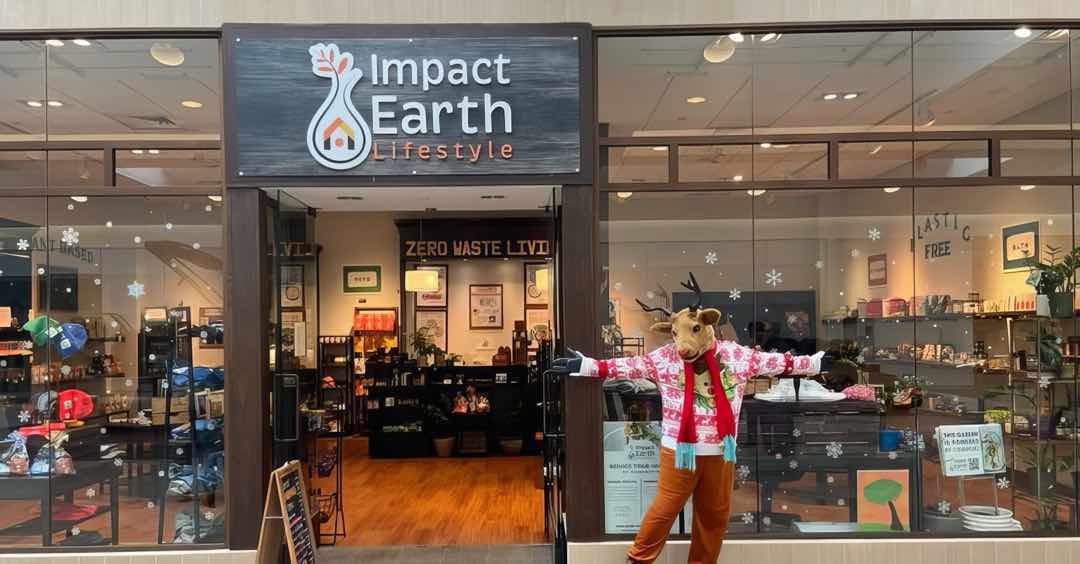
Ad for sales representative, Impact Earth Lifestyle, Eastview Mall, Jan 1, 2023. Facebook
The Eastview Mall store opened during the winter of 2020 and became self-sustaining, drawing customers from all over the region, but eventually closed after the family found their dream location on Monroe Avenue. The Monroe Avenue store has become something slightly different: part shop, part meeting place, part experiment in what a community-centered economy can look like.
Impact Earth, 1485 Monroe Avenue, opened on January 2, 2023
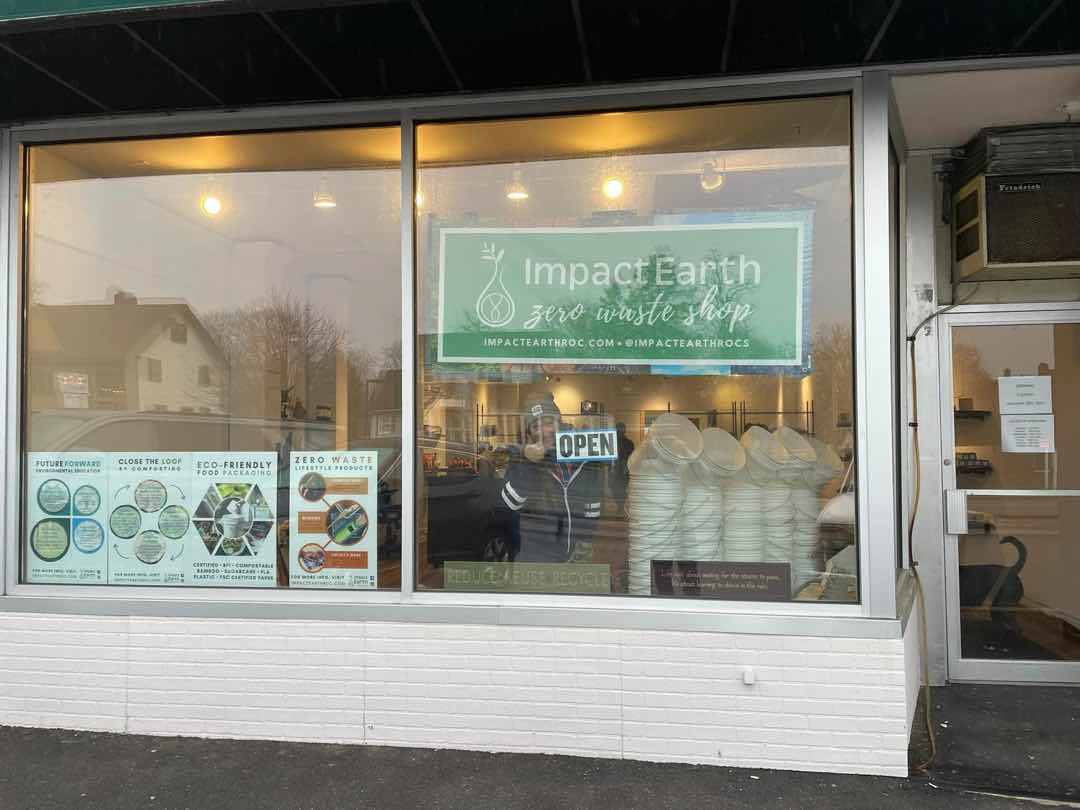
Opening of Impact Earth,. Facebook (Photo credit R.Putney)
Robert and his wife Elizabeth had been looking for affordable space on Monroe Avenue for five years. Fortunately, their current landlord believed in their vision for a place that would be more than a store.
The open space in the front of the store is meant for community. Meetings for local environmental groups, puppet shows, board-game swaps, compost drop-off and pick-up, and informal gatherings all happen there. It just happens to be a retail store and composting center as well.
Near the front is a small table with a few chairs, a copy of the Good Newspaper, and a handful of brochures. Robert offers coffee from the nearby pot and says, “Everything is local these days. Everyone has a megaphone. We could ignore a lot of things in the early days, but we can’t afford to now. I like to read good news.”
Even on a dreary January Sunday, several people came into Impact Earth’s Brighton retail store. One woman had come from a 19th Ward food kitchen carrying vegetable scraps she had salvaged from the cooks. Not only did she bring a bag of compostable material, she paid five dollars for Robert to take it.
In return, Robert gave her a book and a calendar that he had purchased from me for seventy dollars.
Impact Earth does not spend much money on marketing, in part because Robert is the kind of person who will spend seventy dollars on a five-dollar contribution and a bag of food waste, but neighbors are delighted they are there, and word of mouth brings people in every day.
Robert is the very personification of a gift economist. A gift economy is one in which goods or services are given without a fixed agreement about payment or trade. Instead of monetary gain, the rewards are often intangible — a sense of contribution, community, honor, or shared purpose. That spirit seems to follow Robert wherever he goes.
Impact Earth Composting Business
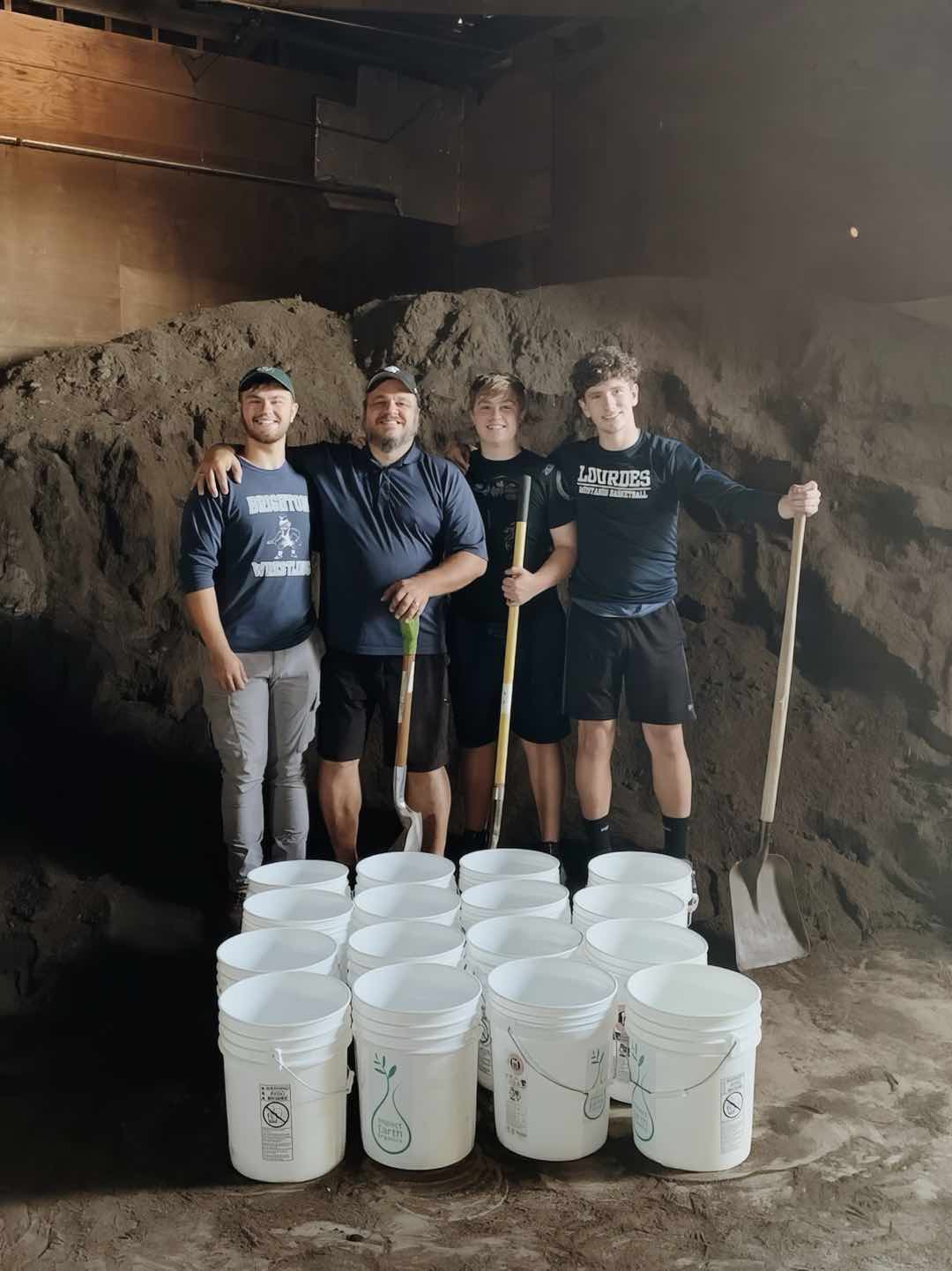
Robert and 3 of his 7 children (Elias, Beckett & Bryce). Facebook (Photo credit R.Putney)
Impact Earth’s composting operation is done through swaps (a bucket or bin for food scraps) at farmers markets, bakeries, restaurants, schools, offices, and multifamily residential buildings, along with curbside collection, commercial services, school programs, and a farm site in Seneca Castle where the organic material is turned back into soil. Customers see firsthand how easy it is to turn organic waste into something useful when they receive a bucket or two of rich compost each year.
The composting operation requires trucks, drivers, washing stations, and a great deal of coordination. It also requires trust. Robert has invested much of his own money over the past decade and has built the business slowly, often with the help of his own children and a crew of young employees who learn by working alongside him. He says openly that he is not in it for the money. There is risk, and there are always bills to pay, but he believes the work matters.
Impact Earth and Environmental Justice
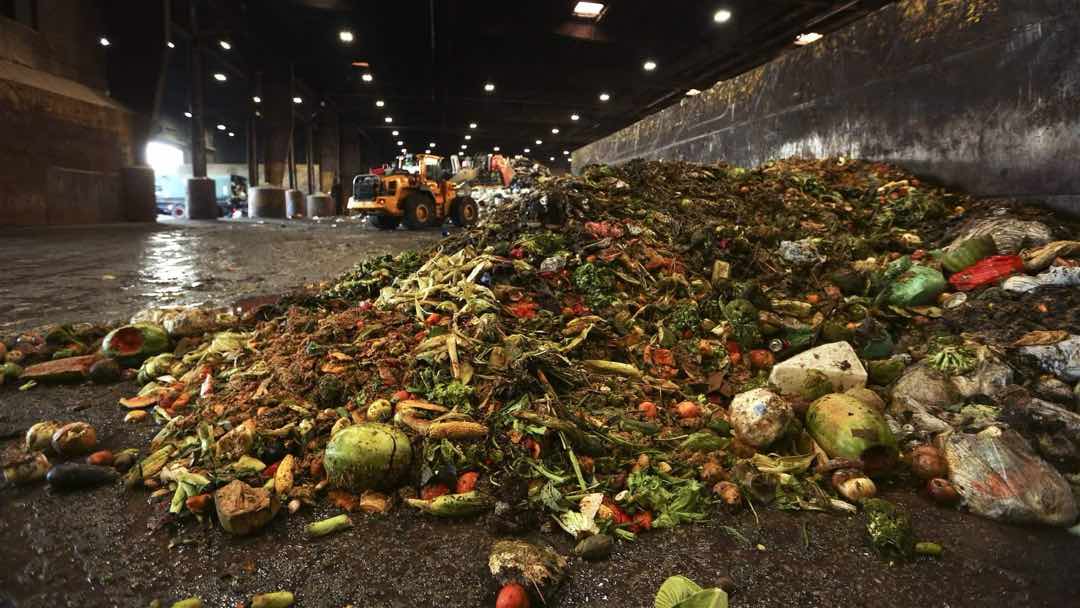
Food Waste: The Shocking Truth About Our Throwaway Culture by Jodie Phillips, in Sustainable Living
Environmental Blog, Jul 9, 2024
Impact Earth’s work touches environmental justice in many practical ways. Their programs reduce waste, expand access to sustainable practices, and build partnerships across the community. They provide residential, commercial, school, and event composting services that keep food scraps out of landfills. They help schools, municipalities, and organizations create waste-reduction systems so that responsible choices are easier for everyone. They offer workshops and hands-on programs that show how daily habits affect the environment and how those habits can change. They organize donation drives that keep usable goods out of the waste stream and get them to people who need them. They host community events, art exhibits, and collaborations that make environmental awareness visible and accessible.
Impact Earth, Collaborations

Community Composting 2020. Brent & Miguel at a local community garden. Facebook
Robert is also a natural collaborator. Over the years he has worked with the Public Market, Greentopia, Abundance Coop, Climate Solutions Accelerator, local schools, local businesses, and many individuals who share his belief in circular economies and true zero waste. He sends out surveys, asks questions, listens to advice, and keeps building relationships. His goal is not simply to run a business, but to help create a network of people who are trying to live differently.
What strikes me most is that Robert does not talk about competition. He talks about collaboration. When I think about Robert, I am reminded of Will Rogers’ saying, “I never met a man I didn’t like.” It would be hard to imagine anyone who doesn’t like him, or whom he doesn’t find a way to work with.
He once said to me, “The only solution is for all of us to band together and do our part to restore balance with Mother Earth and with each other.”
I do not know why Robert befriended me years ago, or why he has done so many favors for A Frog House. He certainly does not need me. But I am grateful, and inspired. And that, I suppose, is what friends and environmental heroes are for.
All photos other than the CITY photo were provided by Robert Putney.
